


- Joined
- 25 Aug 2026
- Messages
- 2
- Reaction score
- 1
- Points
- 3
 BitResurrector: Autonomous Bitcoin Private Key Discovery & Damaged Seed Phrase Reconstruction
An engineering breakdown of secp256k1 keyspace scanning, in-RAM Bloom Filter balance auditing, mnemonic reconstruction under severe physical media destruction, and competitor benchmarks.Download BitResurrector from Official Source
1. Earning Potential in Main Engine Mode: Keyspace Scanning
The Bitcoin decentralized ledger has been operating continuously since 2009. During the early developmental eras, millions of users generated private keys on fragile hardware, formatted storage drives, misplaced paper records, or forgot passphrases. On-chain forensic studies indicate that approximately 3.5 to 4 million Bitcoins have remained completely stationary for over a decade. These dormant assets constitute an immense cryptographic necropolis waiting to be located.The primary operational mode of BitResurrector is engineered to methodically explore the discrete logarithm field of the secp256k1 elliptic curve, uncovering abandoned and forgotten wallet outputs possessing positive asset balances.
Local In-RAM Bloom Filter Architecture
Traditional search scripts suffer from a crippling architectural flaw: an absolute reliance on external RPC nodes and public API gateways. Transmitting network requests to verify address balances incurs severe round-trip latency, triggers aggressive rate-limiting, and exposes search queries to third-party observers. Scanning billions of candidate keys across an internet connection would require centuries.BitResurrector solves this problem at the hardware level. The software maps an optimized, probabilistic Bloom Filter matrix directly into 256MB to 512MB of local physical RAM upon launch. This data structure indexes every single active Bitcoin address in historical blockchain history with an unspent positive balance (> 0 SAT). A local balance lookup takes an astonishing 15 nanoseconds without emitting a single byte of network traffic. This allows users to conduct operations in a hermetically sealed Air-Gap environment completely disconnected from the internet.
Local in-RAM Bloom Filter evaluation: sub-microsecond balance verification without external network traffic
Hardware Acceleration Core
The core computational engine is written in native C++20 and hand-optimized assembly, utilizing AVX2 and SSE4.2 vector SIMD instruction sets alongside massive parallel processing across NVIDIA (CUDA) and AMD (OpenCL) graphics processors. This delivers millions of keyspace derivations per second on consumer workstations.AVX2 SIMDNVIDIA CUDAOpenCL Acceleration
Universal Multi-Format Derivation
Upon generating scalar key material, the engine derives all public address representations simultaneously: Legacy (P2PKH starting with 1), Nested SegWit (P2SH starting with 3), Native SegWit (Bech32 bc1q), and modern Taproot (BIP-86 bc1p), guaranteeing comprehensive coverage of all protocol eras.P2PKHP2SHBech32Taproot BIP-86
2. Seed Recovery Mode with Smart Filters and Random Gen
Beyond raw private key exploration, BitResurrector incorporates a dedicated Seed Recovery module. This subsystem serves a dual purpose: reconstructing damaged user seed phrases and performing targeted stochastic phrase generation via Random Gen coupled with rigorous statistical barriers.Mathematical Entropy Pruning and Derivation Filtering
Under the BIP-39 standard, the final word (word #12 or #24) acts as a strict SHA-256 bitwise checksum. While raw combinatorial permutations across the 2,048-word dictionary seem insurmountable, BitResurrector eliminates 93.75% of invalid word permutations upfront before initiating derivation. Operating alongside Random Gen, users can deploy aggressive probabilistic barriers:- Word Uniqueness Filter (Smart Mode): Empirical analysis shows that over 96.8% of authentic user-generated BIP-39 phrases contain zero duplicate words. Enabling Smart Mode instantly strips trillions of repetitive iterations from the search space.
- Selective Derivation Pipeline: Users can isolate specific high-velocity derivation routes (e.g. BIP-84 Native SegWit or Electrum v2 Modern), achieving up to a 3.5x multi-core speedup by avoiding unneeded computation branches.
- CSPRNG Statistical Filters: Integrated Monobit checks, bit run tests, and entropy variance barriers filter out low-quality pseudorandom noise, focusing resources purely on cryptographically viable structures.
- Autonomous Targetless Auditing: Even when the original public address is completely forgotten, each derived candidate phrase is audited against the in-RAM balance index in nanoseconds, immediately flagging funded wallets.
3. Restoring Damaged Seed Phrases: 7 Real-World Cases
Physical storage media inevitably suffer mechanical degradation, liquid spills, fire exposure, and legibility loss over time. Below is a detailed technical walkthrough of seven classic physical disaster scenarios and the specific mathematical algorithms BitResurrector employs to restore each one.Case 01: Torn Paper Edge (Missing Final Two Words #11 and #12)
Prefix Recovery & Checksum Pruning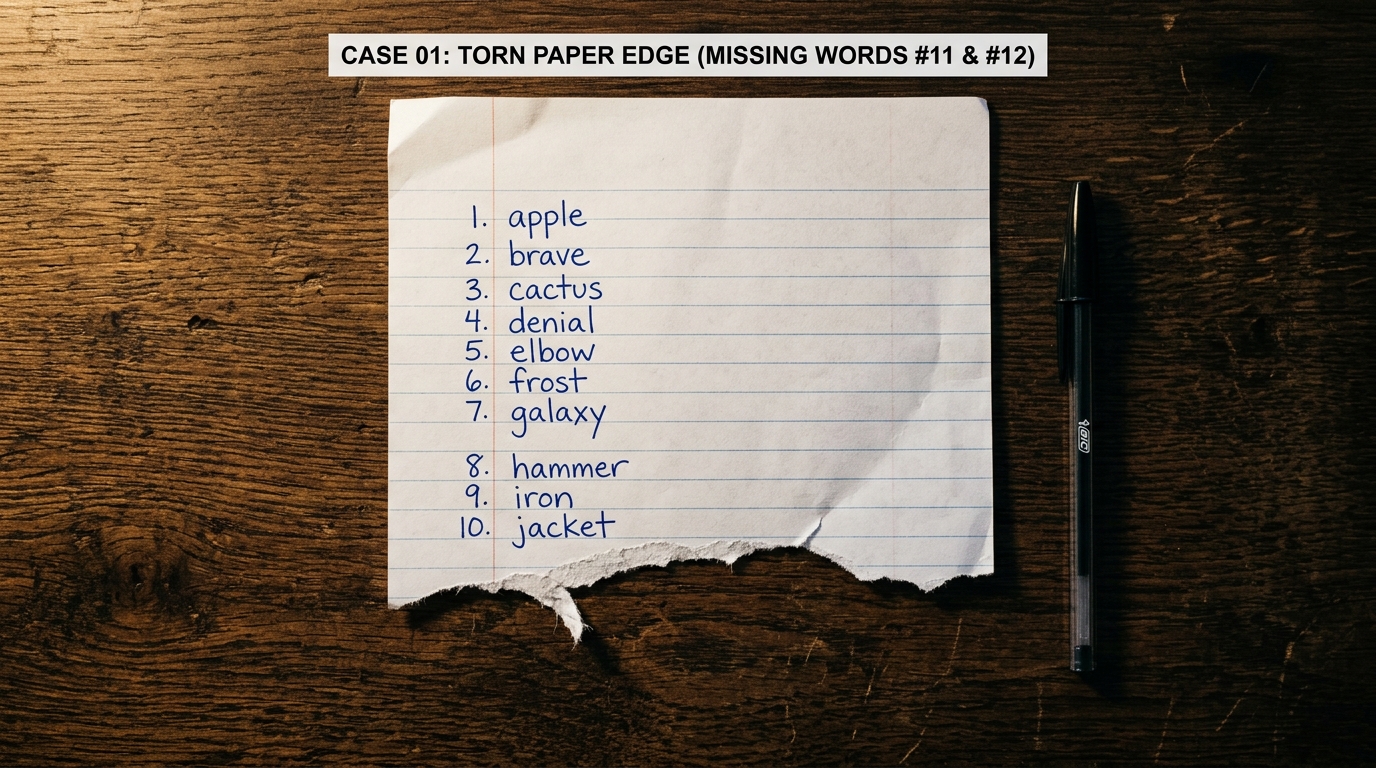
Disaster Scenario
A paper backup of a 12-word seed phrase was stored in a protective sleeve, but accidental mechanical tearing destroyed the bottom section. Words #1 through #10 are completely intact and legible, while words #11 and #12 are missing. Standard wallet software rejects the sequence due to an invalid checksum error.BitResurrector Mathematical Solution
A blind search across two missing slots in the BIP-39 dictionary involves 2,048 × 2,048 = 4,194,304 permutations. However, word #12 contains a 4-bit SHA-256 checksum of the entire sequence. BitResurrector prunes 93.75% of candidates at the bitwise level, leaving exactly 262,144 mathematically valid phrases. By testing candidate addresses against the in-RAM positive-balance database, the funded wallet is located in 15 to 20 seconds.Step-by-Step Procedure
- Open the Seed Recovery window and select «Slot Grid Mode».
- Populate legible words #1 through #10 into their corresponding numbered slots.
- Leave slots #11 and #12 empty for autonomous brute-force evaluation.
- Leave the target address field empty to activate autonomous in-RAM balance auditing.
- Click «START RECOVERY». The authentic mnemonic sequence is revealed in seconds.
Case 02: Coffee or Water Stain (Word #7 Blurred, First Letter & Length Known)
1-Click Constraint Filter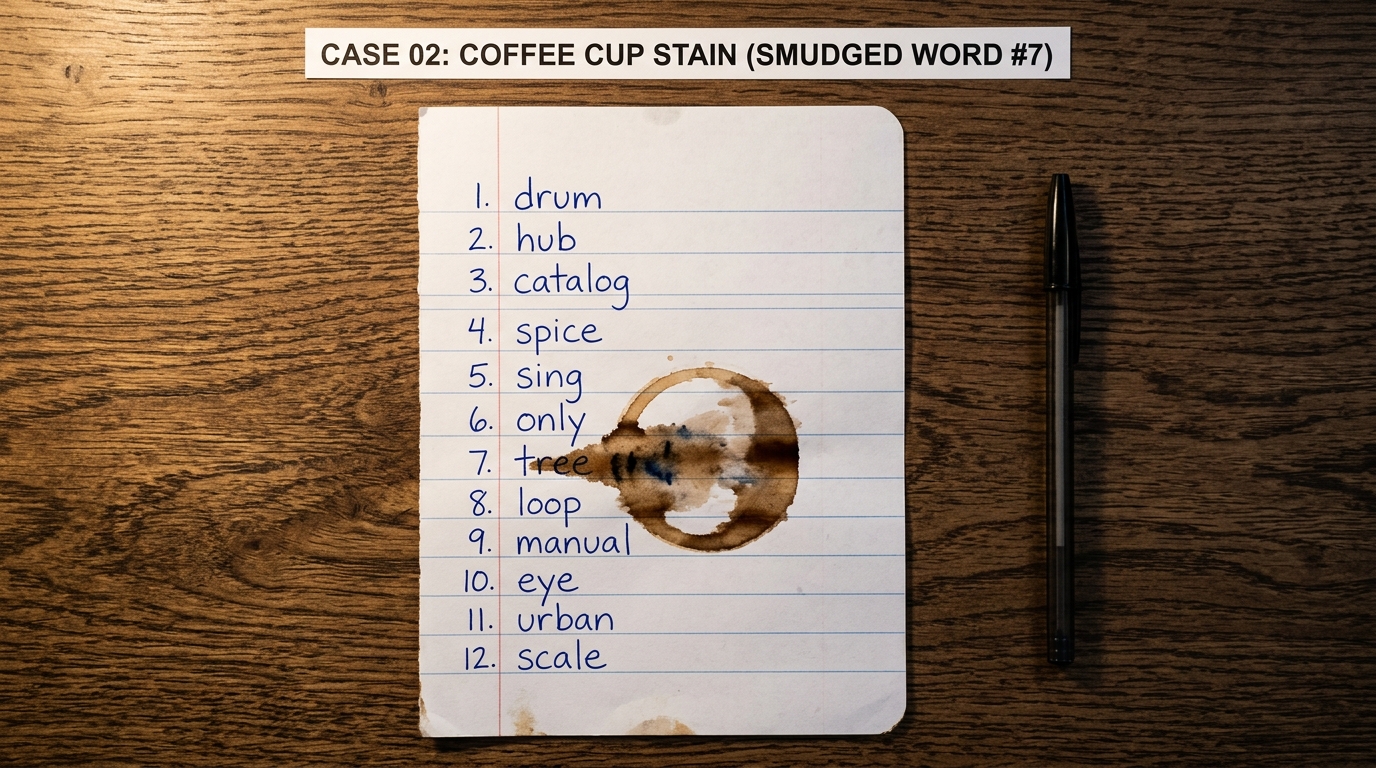
Disaster Scenario
Liquid was spilled over the paper backup sheet. Moisture caused ink on word #7 to bleed into an illegible smear. Although the full word cannot be read, the initial character «t» remains distinct, and the spacing indicates a word length of exactly 4 characters.BitResurrector Mathematical Solution
Rather than evaluating all 2,048 words in the BIP-39 dictionary, applying the 1-Click Constraint filter (letter «t» + 4 characters) restricts the slot candidates to just 15 matching dictionary entries. The search entropy is compressed by 136x, and candidate addresses are audited against the in-RAM balance index in under 0.05 seconds.Step-by-Step Procedure
- Fill slots 1 through 6 and 8 through 12 with legible words.
- Click slot #7.
- On the quick filter panel, select initial letter «T» and word length «4».
- Click «START RECOVERY». The funded wallet is identified in less than 0.05 seconds.
Case 03: Circular Metal Disc (Endless Ring of Words, Unknown Starting Index)
Cyclic Rotations Engine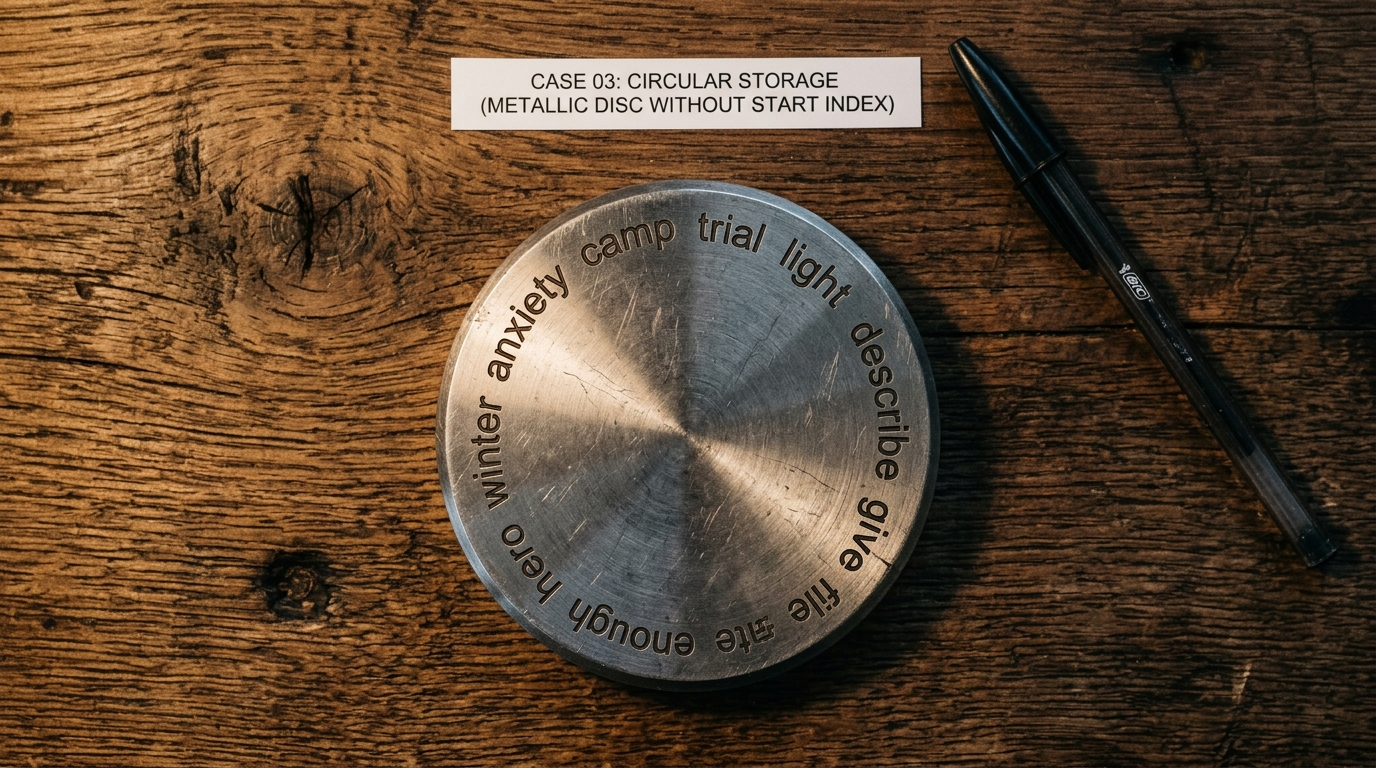
Disaster Scenario
Twelve words were stamped along the outer rim of a circular titanium disc. The disc possesses no index numbers and lacks an initial start arrow. While the full looping sequence of words is known, the true starting word is uncertain.BitResurrector Mathematical Solution
For a circular loop of 12 words, exactly 12 cyclic rotations exist. Because the 4-bit SHA-256 checksum is tightly coupled to the exact positional order of the sequence, rotating the words breaks the checksum. In virtually all scenarios, exactly 1 rotation out of 12 satisfies the mathematical checksum. The engine validates it against the in-RAM balance database in 0.002 seconds.Step-by-Step Procedure
- Enter all 12 words clockwise beginning at any arbitrary position on the disc.
- Toggle the «Circular Rotations» option to ON.
- Leave target address blank for autonomous balance lookup.
- Click «START RECOVERY». The engine identifies the authentic starting point in milliseconds.
Case 04: Two-Column Notebook 2x6 (Row-Wise vs Column-Wise Reading Ambiguity)
Matrix Transposition 2x6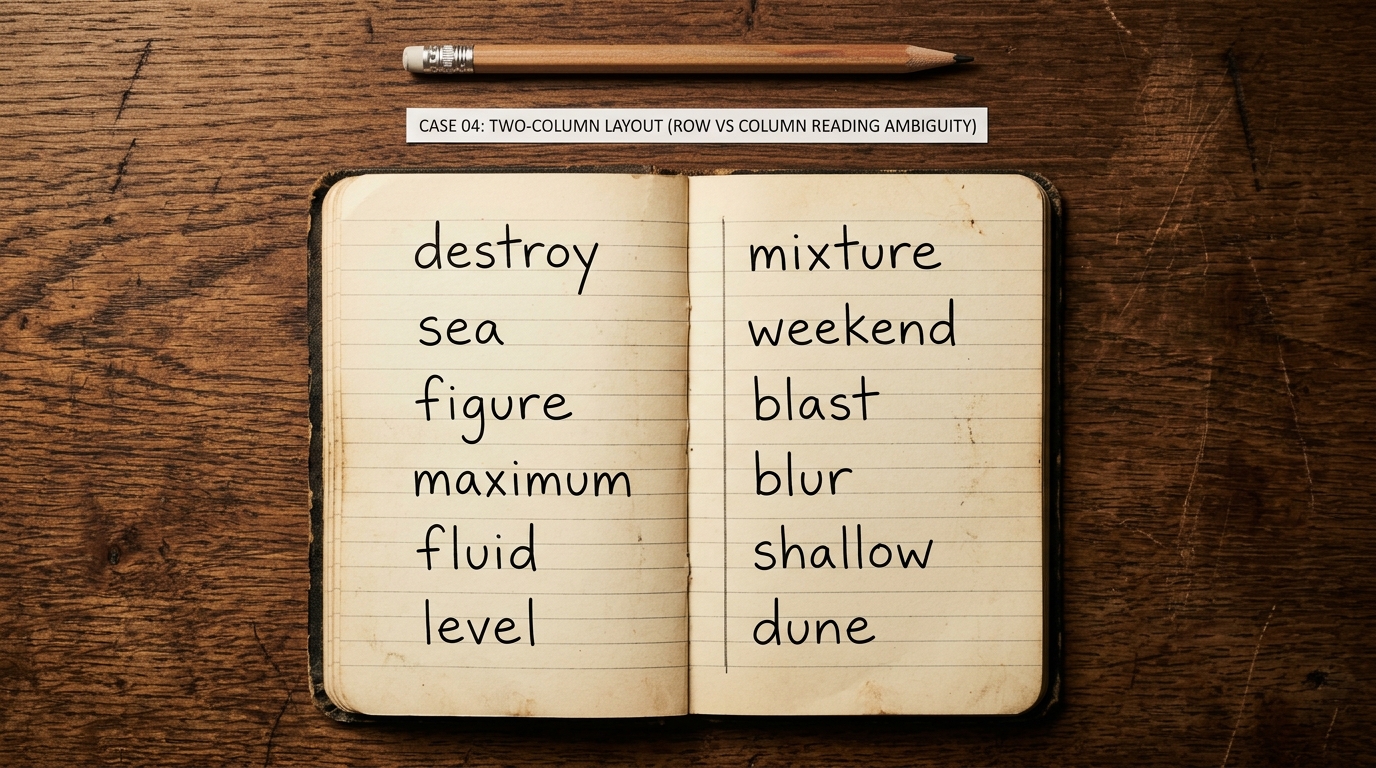
Disaster Scenario
A 12-word seed phrase was written inside a pocket notebook across two parallel columns of 6 rows without line numbers. The owner cannot remember the reading order: horizontally row-by-row (left, right, left, right...) or vertically column-by-column (left column 1–6, then right column 7–12).BitResurrector Mathematical Solution
The Matrix Transposition engine models all reading topologies: row-major forward, row-major reverse, column-major forward, and serpentine paths. The true spatial topology is validated via checksum testing and instant UTXO balance checking within sub-seconds.Step-by-Step Procedure
- Switch to «Scrambled Order Mode».
- Paste the 12 words in the visual sequence they appear on the page.
- Check the box for «Matrix Transposition (2x6)».
- Click «START RECOVERY». The software resolves the layout and outputs the recovered phrase.
Case 05: Fire-Damaged Note (Burn Holes, Partial Letters, and Lengths)
Constraint Mask + Jigsaw Solver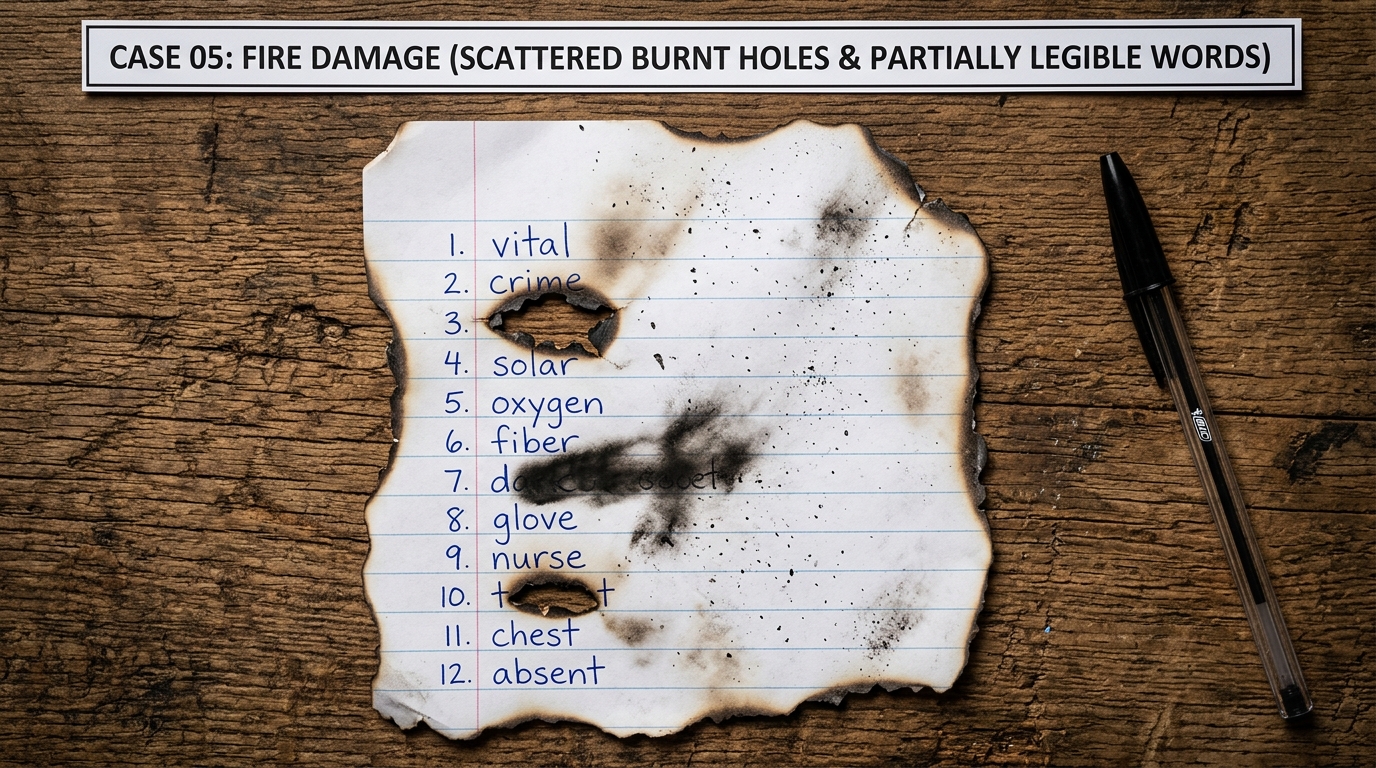
Disaster Scenario
A paper note survived thermal exposure. Damage is uneven: row #3 is burned through (word destroyed), soot on row #7 leaves only the initial letter «d» and length ~6 characters, and burned edges on row #10 preserve letter «t» with length 4. Remaining words are legible.BitResurrector Mathematical Solution
Unconstrained brute-force across three unknown words requires 8.58 billion iterations. BitResurrector applies parametric masks: slot #7 compresses to 15 candidates, slot #10 to 12 candidates, while slot #3 undergoes full dictionary derivation with SHA-256 checksum validation. Search space shrinks 11,000x down to 23,040 valid phrases, evaluated in less than one second.Step-by-Step Procedure
- Input all surviving words into their grid positions.
- Leave slot #3 empty for dictionary evaluation.
- For slot #7, set mask: letter «D», length «6».
- For slot #10, set mask: letter «T», length «4».
- Click «START RECOVERY». The funded wallet is restored almost instantaneously.
Case 06: Messy Handwriting, Smudges & Phonetic Typos (SatoshiLabs Clusters)
Levenshtein Matching & Error Clusters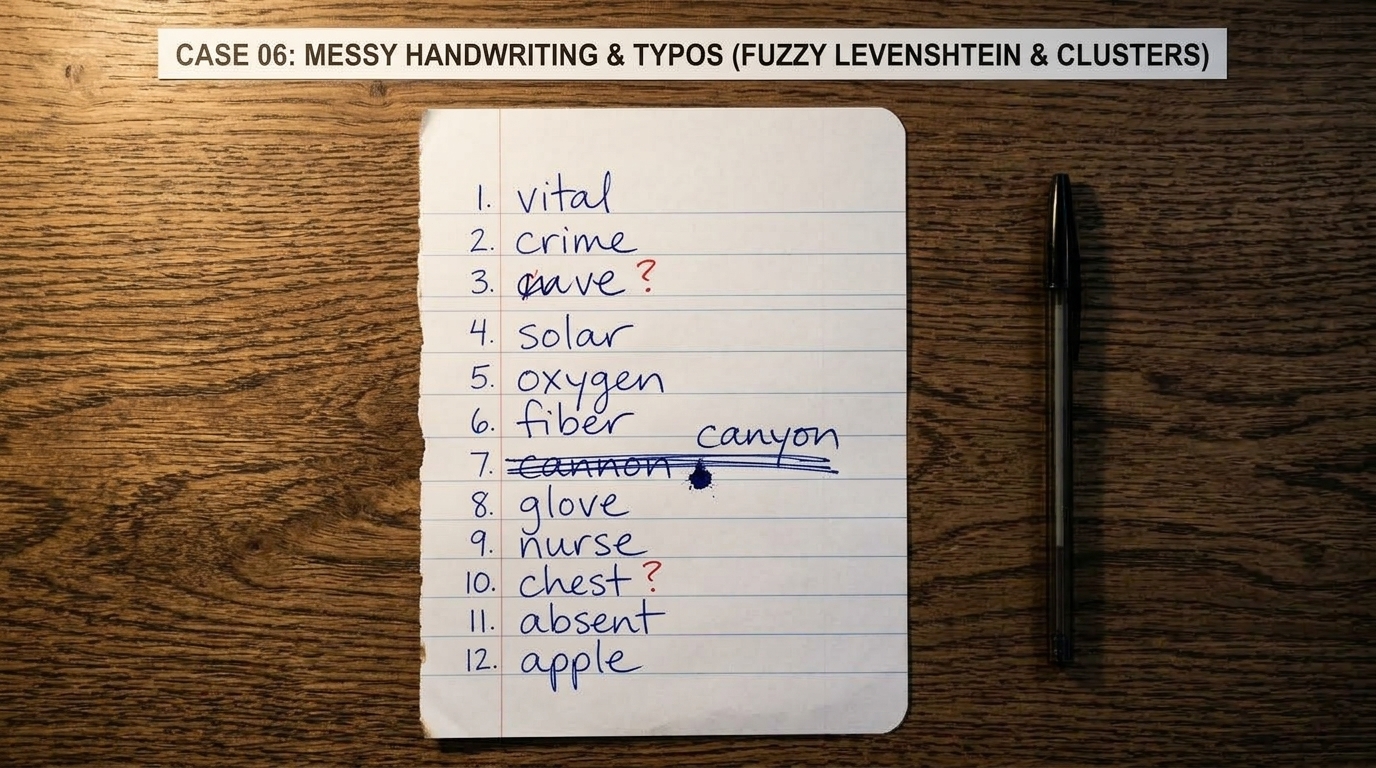
Disaster Scenario
A seed phrase was written down hastily. Word #3 is smudged and ambiguous between «cave» and «wave», while word #7 features an auditory spelling error («cannon» instead of «canyon»). Standard wallet clients reject the sequence outright.BitResurrector Mathematical Solution
The framework embeds the SatoshiLabs repository of 271 homophone error clusters (501 confusion pairs) along with Levenshtein distance metrics. When entering placeholder question marks (e.g. c?ve), the system pinpoints the viable dictionary candidates and validates the single mathematically sound combination through checksum and balance auditing.Step-by-Step Procedure
- Enter all unambiguous words into the grid.
- For illegible words, use question mark placeholders (e.g. c?ve) or select from suggestions.
- Enable the «SatoshiLabs Mistakes» option.
- Click «START RECOVERY». The algorithm verifies correct dictionary spellings and balance.
Case 07: 4-Piece Unruled Fold Split & Crease Abrasion
Quad-Split Combinatorics & Constraint Solver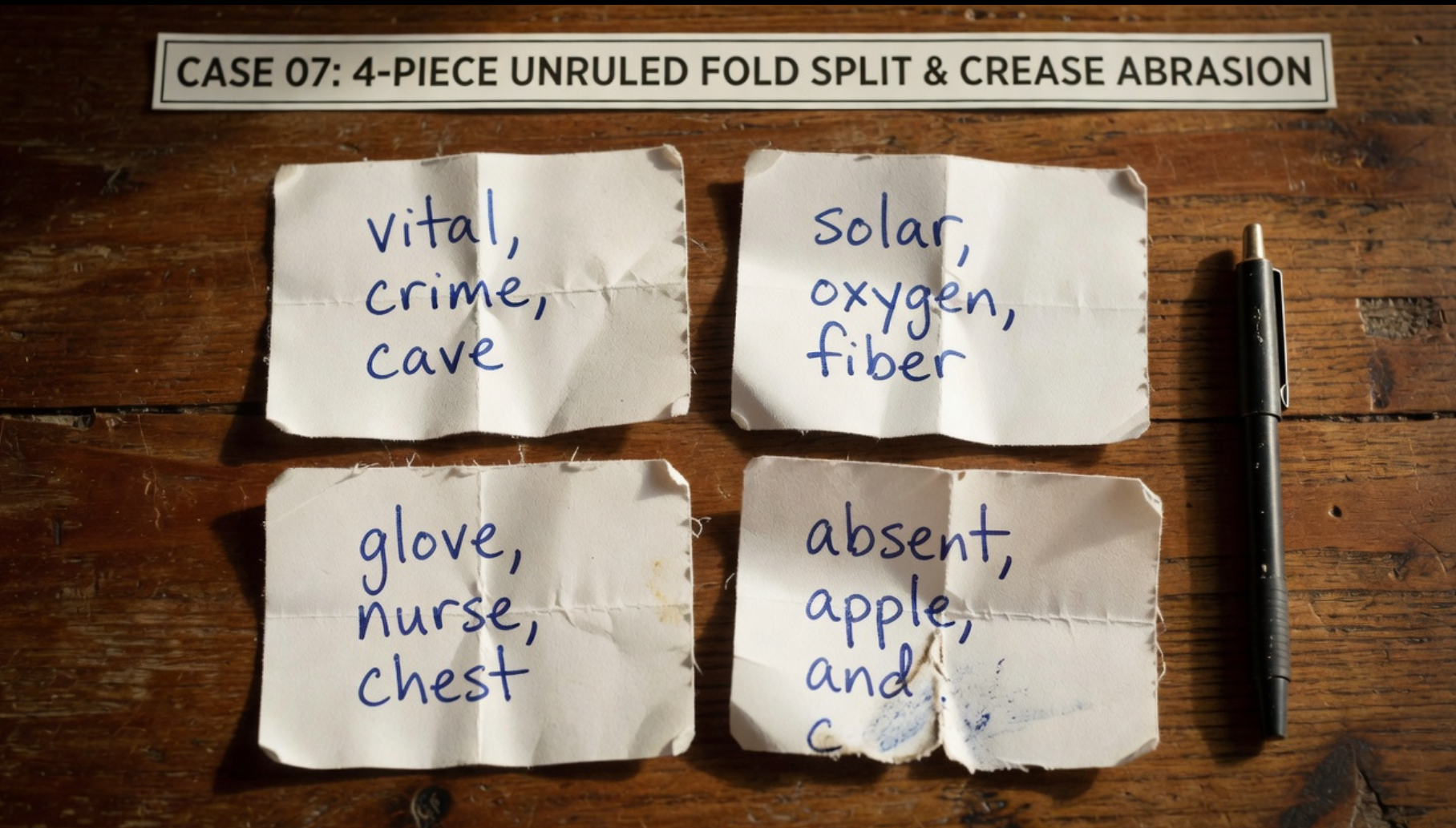
Disaster Scenario
A plain unruled sheet without numbering was folded into quadrants and stored for years. Over time, the paper separated along fold creases into 4 clean rectangular pieces containing 3 words each. Edge matching is impossible because straight fold breaks lack jagged outlines. Additionally, center friction abraded the final word of piece #4, leaving only initial letter «c» and approximate length 6.BitResurrector Mathematical Solution
Four quadrants create 4! = 24 spatial permutations. For the damaged word, mask c***** restricts the BIP-39 dictionary to a compact set. BitResurrector evaluates the 24 spatial routes, tests candidate words, checks SHA-256 checksums, and audits derived addresses against the in-RAM positive-balance database. The authentic wallet is recovered in under 0.05 seconds.Step-by-Step Procedure
- Select «Block Split Recovery» mode.
- Input the 4 groups of 3 words as observed on the separate paper pieces.
- In the slot for the damaged word, specify mask: length 6, leading letter «c».
- Click «START RECOVERY». The software resolves block order and phrase in fractions of a second.
4. Technical Comparison with Competitors & Alternatives
A variety of utilities exist across the crypto landscape: from legacy command-line scripts to commercial supercomputing neural networks. Below is an objective architectural comparison of leading tools.| Evaluation Feature | BitResurrector | AI Seed Phrase Finder | BTCRecover | BIP39-Recoverer | Seed Saviour (ZenGo) | Ian Coleman BIP39 |
|---|---|---|---|---|---|---|
| Execution Core | Native C++20 / ASM Direct machine compilation, AVX2, SSE4.2, CUDA, OpenCL | AI Neural Supercluster High-performance enterprise cloud AI infrastructure | Python Script Interpreted bytecode, GIL multi-threading bottleneck | C++ CLI Utility Basic standalone console compilation | In-Browser JavaScript Confined to single-thread browser sandbox | In-Browser JavaScript Single-thread web tool |
| Targetless Balance Auditing | In-RAM Bloom Filter 256MB–512MB RAM, 15ns lookup across all positive balance addresses | Centralized Ledger Index Sub-millisecond balance resolution on server clusters | Not Supported Strictly requires a known target public Bitcoin address | Not Supported Requires exact destination public address | Not Supported Only validates mathematical checksum validity | Not Supported Standard key derivation utility only |
| Throughput Speed | Hundreds of Thousands / sec GPU OpenCL/CUDA & multi-core CPU SIMD acceleration | Millions / sec Distributed server GPU clusters with AI optimization | 2,000 – 6,000 / sec Limited by Python runtime overhead | 10,000 – 25,000 / sec Bounded by local CPU thread capacity | 100 – 300 / sec Severe browser execution throttling | Manual Input Not designed for batch derivation |
| User Interface | Visual Interactive GUI 12-slot visual grid, character masks, real-time telemetry | Minimalist Dashboard Streamlined 3-field input workflow | Terminal CLI Only Complex command flags, token syntax, and config files | Terminal CLI Only Console prompts without visual feedback | Basic Web Form Single linear input list | Web Page GUI Extensive technical input options |
| Air-Gap Security | 100% Offline (Air-Gap) No internet connection required; keys never leave hardware | Cloud Processing Processing occurs on distributed remote clusters | 100% Offline Executed locally on user machine | 100% Offline Local execution | Browser Execution Vulnerable to browser extensions and script injection | Offline HTML Can be saved and executed from local disk |
| Cost & Licensing | Free Toolkit Full feature set available without subscription fees | Subscription Service Tiered pricing for supercomputing cloud compute time | Free (Open Source) Requires technical Python proficiency | Free Limited to basic single-case scenarios | Free Restricted to recovering at most 1 missing word | Free Educational utility for mnemonic inspection |
Analytical Summary
Command-line utilities such as BTCRecover demand substantial technical expertise in environment configuration and Python dependencies. Crucially, without a known destination address, BTCRecover cannot function. Browser-based tools such as Seed Saviour are restricted by JavaScript execution limits, making them incapable of solving more than a single missing word.BitResurrector bridges the gap by delivering industrial workstation performance: native C++/CUDA speed, intuitive visual damage constraint filters, and fully autonomous in-RAM balance auditing operating entirely offline.